Showing posts with label ice cream. Show all posts

Thursday, 21 November 2013

Overclocking.... lunch

Ok.... where do I begin?  For those of you that don't know what overclocking is here is a brief explanation (It's from Wikipedia so please forgive me if it is not correct):
Overclocking is the process of making a computer of component operate faster than the clock frequency specified by the manufacturer by modifying system parameters.  Operating voltages may also be changed (increased), which can increase the speed at which operation remains stable.  Most overclocking techniques increase power consumption, generating more heat, which must be dispersed is the chip is to remain operational. 
Now, with all that extra heat being generated systems need to be cooled... there are several techniques for doing this.... according to Wikipedia:
 Overclocked circuits can require more cooling, such as by powerful fans, larger heat sinks, heat pipes and water cooling...
I have had the privilege of witnessing many overclocking attempts at different editions of Campus Party, most memorably in Valencia and Mexico, and their use of liquid nitrogen for cooling - never "powerful fans", "larger heat sinks" or "water cooling".  But the wonderful and powerful LIQUID NITROGEN.

There is a fine line between nutrition and geekness in my life that quite often gets blurred.  So to honor my husband (a geek) and all those amazing Campuseros out there all over the globe, I decided this week, to erase that fine line between nutrition and geekness and bring to you the fun of overclocking your lunch... or cooking with liquid nitrogen.

Yes, you can cook with liquid nitrogen and even dry ice.  Extreme cold produces the same effects as heat on food.  Just one word of warning though... please be VERY careful.  If you are an overclocker you will know the dangers of working with liquid nitrogen.  However, if you decide to try this and you have never worked with liquid nitrogen before please follow all the safety regulations associated with the transportation and management of Liquid Nitrogen (LN2) and remember to wear gloves, eye protection such as goggles, and please, no bare feet or shorts or t-shirts - cover up, if it splatters any bare skin it lands on will be burnt.  Also please work in a well ventilated room.  Also remember that this is VERY COLD.  According to Jeff Potter, author of Cooking for Geeks he says:
"When it comes to working with liquid nitrogen, I find it easiest to work with a small quantity in a metal bowl placed on top of a wooden cutting board.  Keep your eyes on the container and avoid placing yourself in a situation where, if the container were to fall, you would find yourself getting splashed."

So how can you cook with LN2

With liquid nitrogen you get almost instant freezing for any product it comes into contact with.  The cold has a similar effect on food as heating removing the liquid content.  This means that it not only changes the original appearance of food, but also its texture, so you can obtain powdered oil or frozen foams.  For example you can freeze a flower and then smash it against something to shatter it to make flower dust.  It also enables you to play with temperature contrasts so you can serve a dish in which the inside ingredient is cooked and kept at its ideal eating temperature, while the outside is completely frozen.

Apart from its creative potential, the use of liquid nitrogen in cooking means you can also speed up cooking times by eliminating any bacterial growth or freeze fluids with minimum ice crystal formation.  It also freezes foods that cannot be frozen in a normal freezer such as products with a high alcohol content.

An obvious dish for cooking with liquid nitrogen is ice cream!  So here is a recipe for you to try... I would be really interested in hearing your experiences!

Cocoa-Goldschläger Ice Cream (Jeff Potter, Cooking for Geeks)

1 cup (256g) milk
1 cup (240g) heavy cream
3/4 cup (180g) Goldschläger (cinnamon liqueur)
1/4 cup (80g) chocolate syrup
1/2 cup (80g) bittersweet chocolate, melted
2 tablespoons (25g) sugar
1/2 teaspoon (1g) salt
1/2 teaspoon (1g) cinnamon.
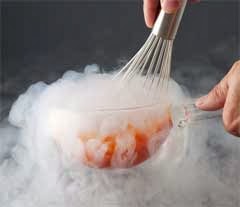
Mix all these ingredients together in a metal bowl and then taste to check the balance (try not to drink it
all), adjust accordingly.  Once frozen, the mixture will not taste as strong, so an overly strong mixture is desirable.  Turn your mixer on (preferably a stand mixer) and then (carefully! with goggles and gloves!) slowly pour in liquid nitrogen.  I find it takes about a 1:1 ratio of mixture to liquid nitrogen to set the ice cream.  If you don't have a stand mixer you can do this in a metal bowl and stir with a whisk or wooden spoon (my advice would be to get someone to help you).

I hope you try it and please let me know how it went!

Social Nutrition:
You can make an appointment to improve your health with Social Nutrition either in person (Madrid) or online (Skype).  Just send an email to lucycarr@socialnutrition.com

Thursday, 28 March 2013

Dairy products linked to a 50% higher risk of dying from breast cancer.

If my previous articles: FORKS OVER KNIVES and THE MILK DILEMA haven't managed to make you rethink your dairy produce intake then I hope this one will.

It is still illegal in the United States to claim that diet can cure cancer, even though there is plenty of evidence to suggest that it can (The Gerson Miracle), or that diet can prevent serious illnesses and plays an important role in curing a disease once diagnosed.

Too many medical doctors do not consider the importance of diet and rely exclusively on modern medicine.  Now, don't get me wrong, I am all for the wonders of modern medicine, but I do believe that doctors need to understand how much better modern medicine would be if combined with a proper disease appropriate diet.

New data has shown that just ONE portion of full-fat dairy per day - be it ice cream or yogurt or cheese cold hinder the survival of women with breast cancer.  Scientists say that women suffering from breast cancer who eat one portion daily could be 50% more likely to die.

Scientists in the US suspect that the reason for this is because milk and other dairy foods contain the hormone estrogen, which is known to encourage tumor growth.

We already know that diet plays an important role in improving the chances of surviving cancer and also preventing its recurrence.  But this is the first study to show such a strong link between dairy products and breast cancer.

1 in 8 women will develop breast cancer at some point in their lives and around 50.000 new cases are diagnosed every year.  Scientists from the Kaiser Permanente research center in California studied the medical records of 1,500 women diagnosed with breast cancer between 1997 and 2000.  The women had all completed questionnaires on how often they consumed dairy products, what size the portions were, and what specifically they ate.  The most common products consumed were ice cream, yogurts, cheese, full-fat lattes and hot chocolate.

The scientists found that the women who ate just ONE portion of just ONE of these products a day, were 50% more likely to die from the illness within 12 years.  They also pointed out that most milk consumed in Britain and the US comes from pregnant cows and is therefore rich in estrogen, which, as I said before, is know to trigger tumor growth and there are particularly high levels in full-fat dairy foods.

In fact, they also found that women who ate ONE portion of full-fat dairy every day were 64% more likely to die from any cause - not just breast cancer.

Dr. Bette Caan, research leader on the study said:
"High-fat dairy is generally not recommended as part of a healthy diet.  Switching to low-fat dairy is an easy thing to modify."
Although, here I have to say; and why not just eliminate dairy all together?  It really is not an essential part of our diets.  All other mammals are perfectly capable of living healthy lives without it after weaning.

Many women who have just been diagnosed with breast cancer ask their doctor whether they should change their diet, but the general consensus within the medical community is that there is just too little research on the subject for them to give any specific advice.

Susan Kutner, chair at the Kaiser Permanente Northern California Regional Breast Cancer Task Force, said:
"Women have been clamoring for this type of information.  They're asking us 'tell me what I should eat.'  With this information, we can be more specific about recommending low-fat dairy products."

Sally Greenbrook, Senior Policy Officer at Breakthrough Breast Cancer, said:
"This study specifically looks at women who have already been diagnosed with breast cancer and how low or high fat dairy products may affect them.  Any women who have had beast cancer and are concerned about their diet should discuss this with their doctors.
"For a number of health reasons it's advisable that all women should follow a healthy balanced diet.  It helps you to maintain a healthy weight which, together with good practices such as low alcohol intake and regular physical activity, can help to reduce your breast cancer risk and improve overall wellbeing.  There are many risk factors to breast cancer, not just diet."
Diet is so important and is given very little credit.  If you want to know more about fighting disease with diet then I can recommend FORKS OVER KNIVES, HUNGRY FOR CHANGE and THE GERSON MIRACLE.  These are all available in DVD and book form, whichever you prefer, but they are incredible documentaries that will, I hope, change your life and health for the better.

Remember, you have the power to change.


Social Nutrition:
You can make an appointment to improve your health with Social Nutrition either in person (Madrid) or online (Skype).  Just send an email to lucycarr@socialnutrition.com