Showing posts with label HFCS. Show all posts

Thursday, 30 October 2014

Be careful with that Halloween candy!

It seems lately that unhealthy foods are being closely related to brain function - and not in a good way.  I recently wrote about how junk food can make you stupid.  Well, with Halloween this week - sugar takes another blow.

I have spoken before about HFCS (High Fructose Corn Syrup) which is basically a chemical form of sugar, but on a much cheaper, unhealthy level.  HFCS has now been associated not just with obesity, type 2 diabetes, cancer, etc., but also with memory disfunction and brain inflammation which leads to dementia and more.

These findings come from a recent study lead by Scott Kanoski and published in Hippocampus.  The study involved 76 adolescent rats that were allowed to consume large quantities of liquid solutions containing sugar or HFCS in concentrations comparable to popular sugar-sweetened drinks, those rats experienced memory problems and brain inflammation, and became pre-diabetic.  Adult rats who were fed the same sugary drinks did not develop the same problems, neither did adolescent rats who did not consume sugar.

This means that adolescents are at a greater risk of problems associated with the consumption of HFCS than adults.
"The brain is especially vulnerable to dietary influences during critical periods of development, like adolescence," said Scott Kanoski, corresponding author of the study and assistant professor at the USC Dornsife College of Letters, Arts and Sciences.
Sugar in large quantities is toxic for the human body, especially inflammatory sugars like HFCS.  The average American teenager gets a huge 17% of their calories from added sugars alone.  That adds up to almost 1/5 of their diet from refined inflammatory sugars.

HFCS is also responsible for provoking leptin resistance.  Leptin is the hormone which helps us to know when we are full.  This leads to overeating, spiked blood sugar levels, and leads to obesity and diabetes.

Obviously there is a huge marketing plan in place to try and make HFCS seem inoffensive - a huge section of the market is at stake here and it is understandable that the manufacturers of HFCS are trying to protect their income and make their product seem healthy or at least - not so dangerous.

One of their messages is that it is the same as normal sugar.  However, it isn't.  Dr. Mark Hyman
explains this:
"HFCS and cane sugar are NOT biochemically identical or processed the same way by the body. High fructose corn syrup is an industrial food product and far from “natural” or a naturally occurring substance. It is extracted from corn stalks through a process so secret that Archer Daniels Midland and Carghill would not allow the investigative journalist Michael Pollan to observe it for his book The Omnivore’s Dilemma. The sugars are extracted through a chemical enzymatic process resulting in a chemically and biologically novel compound called HFCS. Some basic biochemistry will help you understand this. Regular cane sugar (sucrose) is made of two-sugar molecules bound tightly together– glucose and fructose in equal amounts.The enzymes in your digestive tract must break down the sucrose into glucose and fructose, which are then absorbed into the body. HFCS also consists of glucose and fructose, not in a 50-50 ratio, but a 55-45 fructose to glucose ratio in an unbound form. Fructose is sweeter than glucose. And HFCS is cheaper than sugar because of the government farm bill corn subsidies. Products with HFCS are sweeter and cheaper than products made with cane sugar. This allowed for the average soda size to balloon from 8 ounces to 20 ounces with
little financial costs to manufacturers but great human costs of increased obesity, diabetes, and chronic disease.Now back to biochemistry. Since there is there is no chemical bond between them, no digestion is required so they are more rapidly absorbed into your blood stream. Fructose goes right to the liver and triggers lipogenesis (the production of fats like triglycerides and cholesterol) this is why it is the major cause of liver damage in this country and causes a condition called “fatty liver” which affects 70 million people."
So, if you are handing out sweets this Halloween, try buying healthier sweets that don't contain HFCS.  They may not realize it, but you will be doing those children a favor.

I can help you improve your health.  If you would like to make an appointment with me either in person or via Skype, just send me an email to lucycarr@socialnutrition.com

Thursday, 8 November 2012

The Fructose Controversy

There is fructose and there is High Fructose Corn Syrup (HFCS).

The definition in Wikipedia for Fructose says: Fructose or fruit sugar is a simple monosaccharide found in many plants.  It is one of the three dietary monosaccharides, along with glucose and galactose that are absorbed directly into the bloodstream during digestion.  Fructose was discovered by French Chemist Agustin-Pierre Dubrunfaut in 1847.  Pure dry fructose is a very sweet, white, odorless, crystalline solid and is the most water soluble of all the sugars.  From plant sources, fructose is found in honey, tree and vine fruits, flowers, berries, and most root vegetables.  In plants, fructose may be present as the monosaccharide and/or as a molecular component of sucrose, which is a disaccharide.

The definition in Wikipedia for High Fructose Corn Syrup (HFCS) says:  HFCS - also called glucose-fructose syrup in the UK, glucose/fructose in Canada, Glucose/Fructose syrup in the EU and high-fructose maize syrup in other countries - comprises any of a group of corn syrups that has undergone enzymatic processing to convert some of its glucose into fructose to produce a desired sweetness.  In the United States, consumer foods and products typically use HFCS as a sweetener.  It has become very common in processed foods and beverages in the US; including breads, cereals, breakfast bars, lunch meats,yogurts, soups and condiments.

HFCS consists of 24% water, and the rest sugars.  The most widely used varieties of HFCS are: HFCS 55 (mostly used in soft drinks), approximately 55% fructose and 42% glucose; and HFCS 42 (used in beverages, processed foods, cereals and baked goods), approximately 42% fructose and 53% glucose.  HFCS 90, approximately 90% fructose and 10% glucose, is used in small quantities for speciality applications, but primarily is used to blend with HFCS 42 to make HFCS 55.

Why is there so much HFCS in our diet?  Well, it all comes down to money.  Food manufacturers discovered that they could save money using HFCS instead of sugar - it is cheaper and has a longer shelf life... but that's where the "benefits" stop, and they are only for the manufacturer.

In humans, the consumption of HFCS is responsible for:

1.  Weight gain and obesity.  HFCS increases hunger so you eat more.
2.  Increased risk of developing Type II Diabetes.  Fructose interacts with the carbonated soft drinks to form carbonyls.  Carbonyls are toxic and are linked to diabetes in children.  HFCS promotes a life time risk for diabetes in children 30% risk for boys and 40% risk for girls.
3.  Hypertension and elevated "bad" cholesterol levels (LDL).
4.  HFCS and longterm liver damage - The liver turns HFCS into fat which is stored in the liver creating a condition known as "Fatty Liver".
5. Mercury exposure from HFCS.
6. Creates Insulin resistance which can lead to deadly strokes and heart attacks.
7.  Metabolic Syndrome.

In 1957 HFCS was invented by a pair of researchers named Marshall and Kooi.  Until that invention people had correctly understood that there is no fructose in corn syrup.  Corn syrup contains a different sugar molecule - glucose - which is considerably less sweet than fructose.  Marshall and Kooi developed an enzyme called glucose isomerase that could rearrange the molecular structure of the glucose in corn syrup, and convert it into fructose.  The syrup became sweeter when the glucose was converted to fructose by the enzyme.  HFCS began to be produced on an industrial scale in the 1970s.

According to a USDA report from 1997 in 1970 sucrose (table sugar) accounted for 83% of sweeteners consumed by Americans and by 1997 sucrose accounted for only 43% the rest was HFCS (=56% of sweeteners consumed by Americans).  In another USDA report covering the period of 1970-2003 showed consumption per capita of sucrose versus HFCS in the United States.  The consumption table showed that sucrose consumption fell rapidly while HFCS consumption climbed steadily.  Dr. Alan Gaby (Nutritional Medical Specialist) said:

"The increase in HFCS consumption far exceeds the increase in intake of any other food or food group."

Diabetes is a chronic disease that inflicts nearly 24 million people in the United States and it is understood that approximately 5.7 million Americans remain undiagnosed and on top of that there are and estimated 57 million pre-diabetics.  Here are the projections for the increase in cases of diabetes by country for the year 2030 according to the World Health Organization (WHO) (For more information per country you can visit Diabetes statistics by country:


Country
     2000
         2030
Brazil 
4,553,000
      11,305,000
Colombia
   883,000
        2,425,000
Ecuador
   341,000
           921,000
Mexico
2,179,000
        6,130,000
France
1,710,000
        2,645,000
Germany
2,627,000
        3,771,000
Italy
4,252,000
        5,374,000
Spain
2,717,000
        3,752,000
UK & N.I.
1,765,000
        2,668,000

As you can see they are quite worrying figures.

Insulin resistance is the primary problem with diabetes.  HFCS has been shown to increase insulin resistance which means consumption of HFCS will worsen your diabetes if you already have it or if you are pre-diabetic, it can affect your immune system to the extent that it succumbs to the disease.  However, it is a good idea to keep in mind that some of the major risk factors for diabetes (heredity, obesity, a sedentary lifestyle, an unhealthy diet, high cholesterol and high blood pressure) are in your power to change.  A healthier lifestyle which avoids the consumption of HFCS will lower 3 of those risk factors: obesity, high cholesterol and high blood pressure.

Another worrying health problem is metabolic syndrome.  This is a condition characterized by disorders of lipoprotein metabolism (high cholesterol and triglycerides), hypertension, and hyperglycemia (abnormally high concentrations of glucose in blood).  This syndrome afflicts more than 50 million Americans.  Metabolic Syndrome is the result of the continual influx of HFCS products, which creates insulin resistance.

In 2007, a study from Yale University of Medicine stated "Insulin-resistant individuals in their study were found to have their carbohydrate energy rerouted to liver fat production.  This process elevated the participants' blood triglycerides by as much as 60%, while lowering their HDL (good) cholesterol by 20%".

So, as this is turning into a very long post, I'd just like to finish up by saying two things:

1.  There is nothing to gain from the consumption of HFCS - nothing at all.
2.  Please do not confuse HFCS with naturally occurring fructose in fruits, vegetables, breads and grains which are not harmful to the body although HIGH fructose fruits, vegetables, breads and grains should be used in moderation.


Tuesday, 30 October 2012

Know Your Sugars

All the information thrown at us by food manufacturers can be confusing and reading an ingredient list can be down right misleading.  Instead of writing words that mean something to the person buying the product, they use numbers usually beginning with an E that has no meaning to the general public or a name that is impossible to pronounce.  One piece of advice is: If you can't pronounce it or if it has a number in it then DON'T EAT IT!

One of the big dangers in our diet in modern society and especially in the west is sugar.  It may be delicious and appealing but it does us no good at all.  So if you are interested in understanding a bit more about the sugars in our diet then read on...  Dr. Marcola sums it up brilliantly:

1.  Dextrose, fructose and glucose are simple sugars or monosaccharides.  Glucose and dextrose are basically the same, however, the commonly used term for them in ingredient lists is dextrose.  The difference between these three is the way the body metabolizes them.

2. Simple sugars can be combined to form more complex sugars such as disaccharide sucrose, commonly known as table sugar which is half glucose and half fructose.

3. High Fructose Corn Syrup (HFCS) is 55% fructose and 45% glucose. (I'll get back to this in another post - there is a lot to be said about HFCS).

4.  Sugar alcohols such as xylitol, glycerol, sorbitol, Maltitol, mannitol, and erythritol are not either sugar or alcohol but are used as sweeteners.  For the most part they are incompletely absorbed in the small intestine, therefore providing fewer calories than sugar but can often cause intestinal problems such as bloating, flatulence and diarrhea.

5.  Sucralose (Splenda) is NOT a sugar, it is a chlorinated artificial sweetener similar to aspartame and saccharin, and is damaging to health.

6.  Agave Syrup, this one is confusing as it is promoted as "natural" but is typically highly processed and is usually 80% fructose.   The end product does not resemble the original agave plant in any way, shape or form.

7.  Honey is about 53% fructose but is completely natural in its raw form and contains many health benefits when used in moderation.  Among others it contains as many antioxidants as spinach.

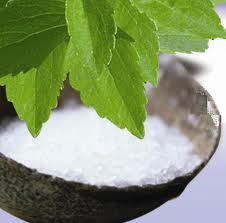
8.  There are natural sweeteners such as Stevia (in the photo) or Lo Han (or Luo Han Guo).  Stevia is derived from the leaf of the South American Stevia plant and Lo Han is derived from a fruit.

It is much better to stick to the the natural sweeteners if you have a sweet tooth.  All artificial sweeteners are harmful to health.  Or you could try kicking the sugar habit and take control of your health.  Watch this space for more information on kicking the sugar habit and HFCS.